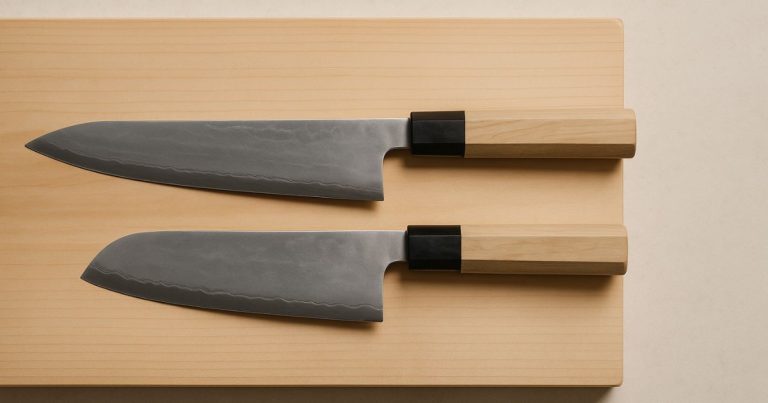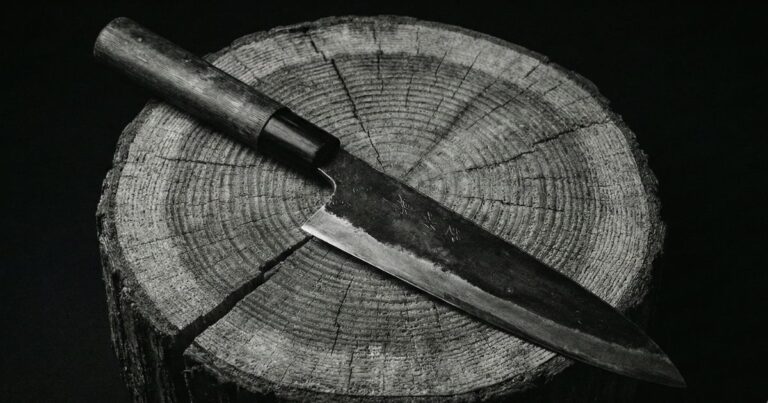
The search for a true vintage Japanese knife rarely begins in a blacksmith’s workshop or even in Japan. These days, the most authentic pieces surface online, scattered across auctions, private sellers, and small specialist shops that quietly list decades-old blades.
However, the digital hunt has its hazards: counterfeits, over-polished edges, laser-etched kanji, and listings so vague they read like haiku written by someone who definitely does not know what a gyuto is.
Knowing the stories behind vintage Japanese knives is essential to understanding what makes these tools so special. This guide shows you exactly where to buy them online and how to evaluate listings with the calm, sharp eye of a seasoned collector. Whether you’re searching for a 1960s gyuto that put in years at a Tokyo sushi bar or a workhorse deba forged in a rural smithy, this will help you spot the real deal.
The Top Sources to Buy Vintage Japanese Knives Online
1. Yahoo! Japan Auctions
Best for: The adventurous hunter looking for volume and raw history.
Yahoo! Japan Auctions remains the most reliable source for authentic vintage blades. Retired chefs, old households, and regional antique shops list knives here regularly — often untouched and unpolished since their working days. You’ll need a proxy service like Buyee, ZenMarket, or FromJapan to bid, but the payoff is worth the small learning curve.
- Pros: Huge volume of genuine vintage knives; many blades in original, unrestored condition; direct access to Japanese private sellers.
- Cons: Requires a proxy service; listings often have limited photos; strict “no returns” policy.
2. eBay
Best for: Accessibility and buyer protection.
eBay is a global mixed bag: sometimes treasure, sometimes a knife that’s been polished so aggressively it now reflects your regret. With patience (and sharp skepticism), excellent finds are possible.
- Pros: Accessible worldwide; hosted by several reputable Japanese knife dealers; some listings offer returns.
- Cons: Many over-restored knives; fake kanji and staged patina are common; photos may hide cracks or over-thinning.
3. Past Knife Catalog
Best for: Curated authenticity and professional preservation.
If you want to skip the gamble of auction sites, our Past Knife Catalog features blades restored by hand using traditional, preservation-focused methods. Unlike random auction finds, every knife we list includes steel type, region, era, and full restoration notes — no mystery metal, no surprise over-polishing.
- Pros: Guaranteed authenticity; restoration that preserves historical character; clear documentation and high-quality photos.
- Cons: Limited stock due to the rarity of the items we select.
4. Direct-from-Japan Knife Shops
Best for: Finding New Old Stock (NOS).
Some Japanese knife shops maintain small stashes of vintage or NOS (new old stock) blades — often only available by email inquiry. These shops sometimes offer pieces that never make it to online auction sites — a collector’s dream scenario.
Recommended sources to investigate:
- Knife Japan – Excellent regional vintage stock.
- Japanese Knife Imports (JKI) – USA-based, occasionally stocks true vintage.
- Sakai Ichimonji Mitsuhide – NOS and vintage available by inquiry only.
Collector’s Checklist: How to Evaluate a Vintage Knife Listing
Use this checklist before you buy anything online to ensure you aren’t buying a lemon:
- Check the Geometry: Look closely at the blade profile. Over-thinning (especially near the heel) suggests aggressive modern polishing that ruins the knife’s taper.
- Inspect the Spine and Choil: Sharp edges here usually indicate machine refinishing. True vintage knives generally have softened, hand-worn curves from years of use.
- Study the Kanji:
- Stamped: Common on older, mass-market knives.
- Engraved (Chiseled): Normal for handmade blades.
- Laser-etched: Almost always a sign of a new knife or a fake.
- Examine the Tang (Nakago): If the handle is off or visible, look for natural dark patina (black rust), file marks, and irregularity. These are all good signs of age.
- Assess the Patina: Natural patina is uneven and organic. Fake patina often looks too artistic or perfectly uniform.
- Check for Structural Issues: Small chips are fine and fixable. Cracks (especially vertical ones at the heel) are a hard pass.
- Confirm Steel Type: Most vintage Japanese knives use White #2 (Shirogami), Blue #2 (Aogami), or SK high-carbon steels.
Beginner’s Guide: Spotting Authentic Vintage Knives
Real vs. Fake Kanji
- Real: Slightly uneven depth, visible hand-engraving cues (chisel entry/exit points), and hammer marks nearby.
- Fake: Perfectly uniform depth, laser-etched sheen, or identical kanji appearing in multiple unrelated listings from the same seller.
Real vs. Fake Patina
- Real: Displays blue, purple, charcoal, and smoky tones with uneven transitions, age spots, and micro-pits.
- Fake: Perfect gradient patina, repeating patterns across different knives, or looks like someone painted the patina on while listening to lo-fi beats.
Signs of Over-Restoration
Avoid knives that show:
- Spine and choil that are sharpened to a crisp 90-degree angle (unnatural).
- Mirror polish with no kasumi (misty) finish on the cladding.
- Blade profiles thinned beyond their era’s standard.
- Partially removed stamps or worn-out logos due to heavy sanding.
Glossary of Useful Terms
- Gyuto: Japanese chef’s knife for general work.
- Deba: Heavy fish-butchery knife.
- Nakago: The tang (the portion of metal inside the handle).
- Kasumi: The “misty,” matte finish found on the soft iron cladding of a blade.
- NOS (New Old Stock): Old knives that have never been sold or used.
- Shirogami (White steel): Pure high-carbon steel known for a very fine grain and sharpness.
- Aogami (Blue steel): High-carbon steel alloyed with tungsten and chromium for toughness and edge retention.
Buying a vintage Japanese knife online is part treasure hunt, part detective work, and part “why does this listing only have two blurry photos?” The good news: the right knowledge turns the uncertainty into an advantage.
With the resources above — and your new collector’s eye — you’ll be able to judge listings confidently, spot authenticity cues, and avoid the polished-to-death pretenders.
Somewhere out there is a blade with decades of quiet service behind it and decades more ahead. Happy hunting — and may all your patina be natural.
Ready to find your next blade? Visit the Past Knife Catalog for our latest restored vintage arrivals.